
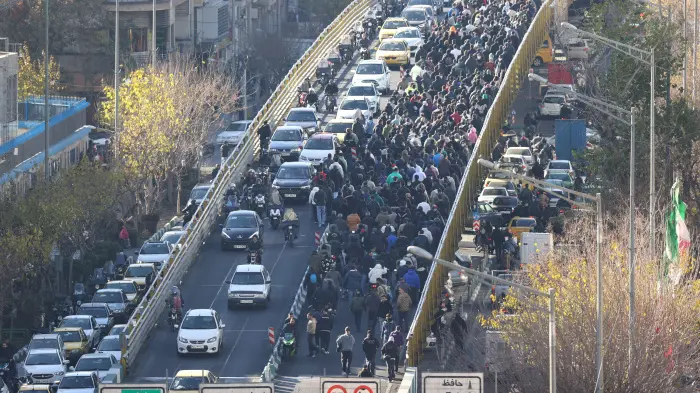
The Islamic Republic of Iran stands at a crossroads. What began as merchants closing shop in Tehran’s electronics bazaars has evolved into the most significant challenge to the regime since the 1979 revolution. As the Iranian rial collapses to historic lows and food prices soar beyond the reach of ordinary citizens, hundreds of thousands have taken to the streets across all 31 provinces. The question is no longer whether Iran faces a crisis, but whether its government can survive it.
A Currency in Freefall, A Nation in Distress
On December 28, 2025, shopkeepers in Tehran’s Alaeddin and Charsou shopping malls made a desperate decision: they shuttered their stores. The Iranian rial had plummeted so precipitously that merchants could no longer calculate prices for their inventory. Every transaction meant a loss. Within hours, the protest spread beyond the bazaar. By New Year’s Day, demonstrations had erupted in over 280 locations spanning from the capital to remote provincial towns.
The numbers tell a devastating story. The rial, which traded at 1.45 million to the dollar on December 29, fell further to 1.5 million by January 6 — a 50% loss in value over recent months. Food prices have risen 72% year-over-year, with dairy products increasing six fold and potatoes by 103%. Meanwhile, salaries increased by only 20%, creating an impossible gap. A family of three in Tehran now needs 550 million rials monthly for basic necessities, yet average incomes cover less than one-third of that amount.
The government’s recent elimination of preferential exchange rates for all products except medicine and wheat transferred the full burden of currency devaluation directly onto consumers. For millions of Iranians already struggling to afford bread and cooking oil, this was the final blow.
From Economics to Existential Crisis
What distinguishes these protests from previous uprisings is their geographic breadth and demographic diversity. This is not merely a movement of urban students or women demanding social freedoms, though both groups are present. Factory workers, ethnic minorities, bazaar merchants, and residents of small towns have joined in numbers not seen in decades. The demonstrations have reached Kurdish regions in the west, Azeri-majority cities in the northwest, and the restive Sistan and Baluchestan province in the southeast.
More significantly, the protests have evolved from economic demands to explicit calls for regime change. Demonstrators chant “Pahlavi will return” and “Long live the Shah,” referencing the monarchy overthrown nearly five decades ago. Others cry “Neither Gaza nor Lebanon, My Life for Iran,” directly challenging the government’s costly support for regional proxy forces while its own citizens suffer.
For the first time, Supreme Leader Ali Khamenei and President Masoud Pezeshkian have publicly acknowledged that international sanctions alone cannot explain Iran’s economic catastrophe. This unprecedented admission amounts to a confession of governance failure. Pezeshkian went further, stating: “If the problems aren’t solved, we cannot govern.” Such candour from Iranian leadership is remarkable, but it offers cold comfort to citizens who cannot feed their families.
Blood in the Streets, Silence in the Digital Sphere
The government’s response has followed a familiar pattern: limited economic gestures paired with security crackdowns. Authorities announced a modest monthly subsidy of approximately seven dollars per household for food staples and temporarily froze some commodity prices. Such measures ring hollow when inflation exceeds 42% and the currency continues its freefall.
The security response has been severe. According to the U.S.-based Human Rights Activists News Agency, which maintains an activist network inside Iran, at least 36 people have been killed, including four children. More than 2,200 individuals have been detained, though the actual number is believed significantly higher. Security forces have deployed tear gas and, in several documented instances, live ammunition.
On January 8, the government implemented a nationwide internet blackout and severed telephone lines, plunging the country into digital darkness. The regime has also called upon approximately 800 members of Iraqi Shiite militia groups, including Kata’ib Hezbollah and Harakat al-Nujaba, to assist in suppressing demonstrations. The symbolism is potent: Iran must import foreign fighters to control its own streets.
Perhaps most disturbing was the reported assault on Imam Khomeini Hospital in Ilam province, where security forces allegedly stormed the facility, beating medical staff and attacking wounded protesters with tear gas. The U.S. State Department characterized this incident as a clear crime against humanity.
The International Dimension: Support, Warnings, and Geopolitical Calculations
The international response has been swift and revealing. President Donald Trump issued an extraordinary statement on January 2, declaring that if Iran violently kills peaceful protesters, the United States will come to their rescue, adding: “We are locked and loaded and ready to go.” This represents a dramatic departure from previous American policy. During the 2009 Green Movement, President Barack Obama deliberately avoided public support for demonstrators, a decision he later acknowledged as a mistake.
Trump’s overt backing presents a complex calculus. While it may embolden protesters, it also provides the Iranian government with evidence to portray the uprising as foreign-orchestrated rather than organically driven by legitimate grievances. History offers cautionary tales about external powers attempting to shape internal revolutions.
Israeli Prime Minister Benjamin Netanyahu similarly expressed support, suggesting Iran may be at a moment when its people take their fate into their own hands. Israel has reportedly increased its military readiness, concerned about potential Iranian actions amid domestic instability.
Russia and China, despite comprehensive strategic partnerships with Iran, have proven unable or unwilling to provide the economic stability Tehran desperately needs. Russia signed a twenty-year cooperation agreement with Iran in early 2025, yet this has not translated into relief from Western sanctions. China’s 25-year strategic deal, valued at $400 billion, similarly fails to offset the harsh consequences of U.S. and European Union sanctions. Chinese oil industry stakeholders reportedly worry about losing access to discounted Iranian crude, but Beijing has offered no rescue package.
Unconfirmed reports suggest Supreme Leader Khamenei may have arranged an escape plan to Moscow should security forces defect to the protesters’ side. While such reports could be disinformation Iranian intelligence has a history of planting such stories the mere circulation of such claims reflects the regime’s perceived vulnerability.
The Perfect Storm: Sanctions, Military Defeats, and Regional Isolation
The current crisis did not emerge in a vacuum. Iran has endured a cascade of setbacks that have converged to create this moment of maximum vulnerability. In June 2025, during the Twelve-Day War, Israel launched devastating attacks that killed senior military leaders and targeted critical infrastructure. The United States subsequently struck Iranian nuclear facilities at Fordow, Isfahan, and Natanz. In September, the United Nations reimpose sanctions through the snapback mechanism, freezing Iranian assets abroad and imposing penalties on the ballistic missile program.
The fall of the Assad regime in Syria represented perhaps the most significant strategic blow. For decades, Syria served as Iran’s crucial link to Hezbollah in Lebanon and its primary foothold in the Levant. That connection has been severed. Iran’s regional proxy network Hezbollah, Hamas, Iraqi militias, and Houthi forces in Yemen has been weakened by Israeli military operations and internal challenges. The protesters’ chants criticizing support for Gaza and Lebanon reflect popular resentment of these costly commitments.
President Pezeshkian’s 2025-2026 budget reveals the government’s priorities: security spending increased by nearly 150% while wage increases amounted to roughly two-fifths of the inflation rate. Such allocation signals a regime more concerned with its own survival than its citizens’ welfare.
What Lies Ahead: Scenarios and Uncertainties
Several factors will determine whether these protests mark a turning point or another chapter in Iran’s long history of state suppression of dissent. The loyalty of security forces remains paramount. In 2019, when protesters challenged the regime, approximately 321 were killed in a brutal crackdown. If the Revolutionary Guard and Basij militia repeat such violence, the current uprising may be crushed, though at tremendous human cost and further eroding the government’s legitimacy.
The internet blackout aims to prevent coordination and information sharing, but protesters have demonstrated resourcefulness in circumventing such restrictions in the past. The question is whether they can sustain momentum without digital communication tools.
International actions will also prove consequential. If President Trump follows through on his intervention threats, the situation could escalate into military confrontation with unpredictable consequences. More likely, continued sanctions pressure combined with diplomatic isolation will further weaken the Iranian government’s capacity to respond effectively.
Economic realities present perhaps the most intractable challenge. The government lacks both the resources and the policy tools to address the crisis. The modest subsidies announced thus far are insufficient to restore purchasing power or stabilize the currency. Structural reforms would require abandoning policies central to the regime’s identity, including its support for regional proxies and its resistance to Western economic integration.
A Regime Confronting Its Mortality
The Iranian people face a moment of profound consequence. For weeks, they have risked death and detention to demand not merely economic relief but fundamental political transformation. The breadth and persistence of these protests suggest something deeper than previous uprisings a widespread loss of faith in the Islamic Republic’s ability or willingness to govern in their interests.
The regime’s own leaders have acknowledged their failure, though acknowledgment without action offers little hope. President Pezeshkian’s admission that the government cannot continue governing without solving these problems was accurate, but solving them would require abandoning the revolutionary ideology and regional ambitions that define the Islamic Republic.
For the international community, Iran’s crisis presents both opportunity and peril. The fall of the Islamic Republic could reshape Middle Eastern geopolitics, potentially creating space for a more moderate Iranian government. Yet such a transition carries enormous risks: sectarian violence, refugee flows, nuclear proliferation concerns, and the possibility of broader regional conflict.
The coming weeks will test whether a theocratic regime built on revolutionary fervour can adapt to the demands of a population that increasingly rejects its authority. The protesters’ courage is undeniable, but courage alone may not overcome the state’s monopoly on violence. History offers no guarantees that justice prevails or that popular will translates into political change.
What is certain is that Iran has reached an inflection point. The economic model is broken, regional power is diminished, and the social contract between government and governed has shattered. Whether this moment leads to reform, revolution, or bloody suppression remains unclear. But the status quo a population enduring economic devastation while its government pursues regional ambitions appears unsustainable.
The world watches as millions of Iranians write the next chapter of their nation’s history. Their struggle deserves international support, but that support must be thoughtful and measured, recognizing that the Iranian people themselves must determine their future. External powers can offer solidarity and maintain pressure on a brutal regime, but the revolution if it comes must be authentically Iranian, owned by those who risk everything for it.
The voices rising from Tehran’s streets carry a simple message: Iranians have endured enough. Whether their government will listen or can even afford to listen may determine not only the fate of the Islamic Republic but the trajectory of the entire Middle East.