
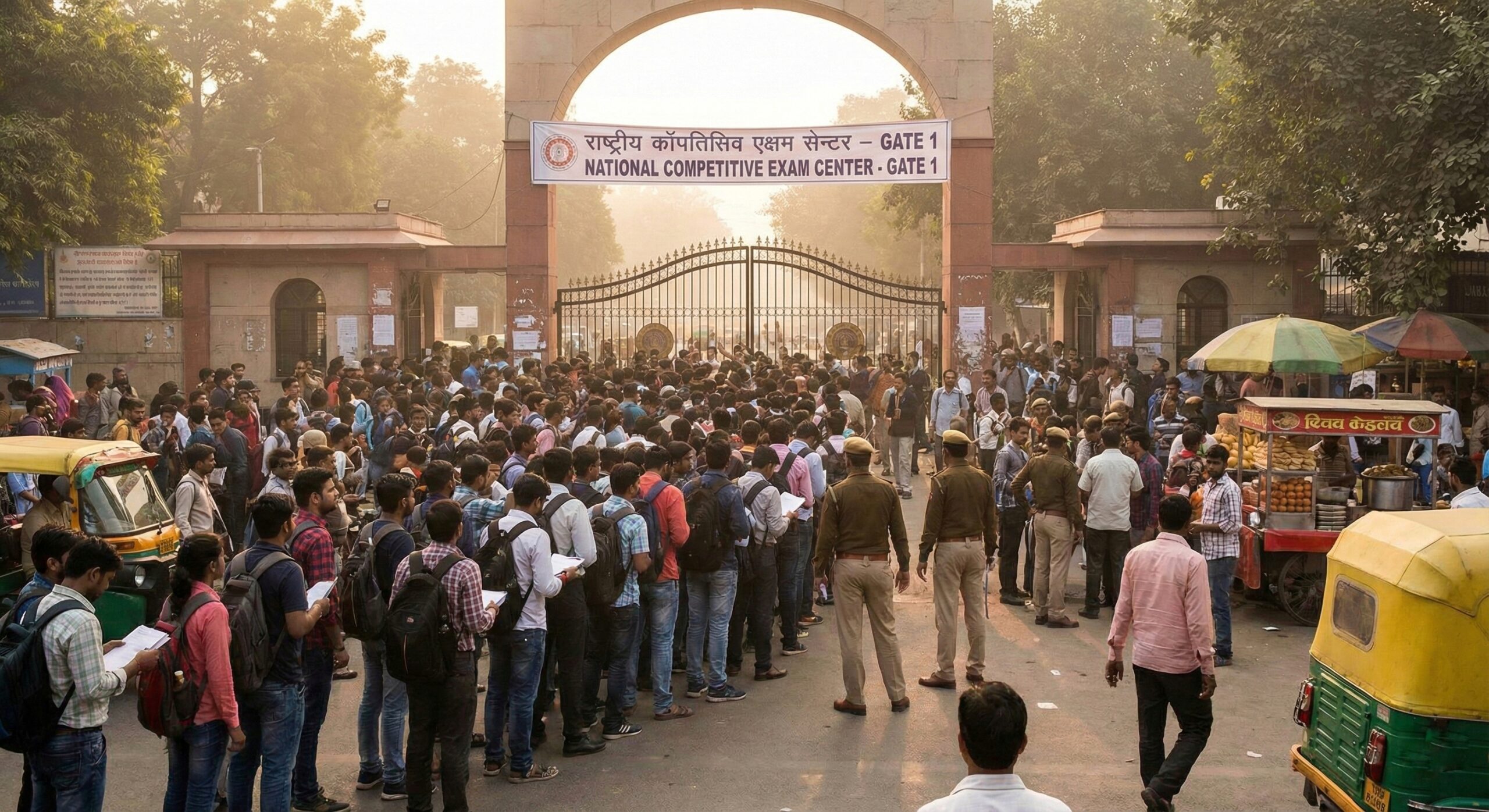
India’s competitive examination system, once heralded as a meritocratic gateway to public service, has devolved into an antiquated relic that betrays the aspirations of millions. Whether conducted by state public service commissions or central bodies like the UPSC, SSC, or Railway Recruitment Boards, these examinations remain trapped in a colonial-era framework, stubbornly resistant to the evolution defining every other sphere of modern Indian life.
The Human Toll of Rote Memorization
The fundamental flaw lies in the architecture of these examinations, which prioritize memory regurgitation over analytical ability. Research confirms what aspirants have long known: the current system exacts a devastating mental health cost. Studies published in medical journals indicate that over 60% of competitive exam aspirants exhibit signs of chronic stress or mild depression. A 2023 survey-based study on UPSC aspirants found that 53.3% of respondents rated their mental health as poor or somewhat poor, with aspirants who attempted the exam multiple times four or more attempts reporting significantly poorer mental wellbeing.
The tragic deaths in Delhi’s coaching hubs in July 2024 including three aspirants who drowned in a flooded basement library at Old Rajinder Nagar represent only the visible fraction of this crisis. Between 2012 and 2022, the number of UPSC aspirants doubled from 5 lakh to over 11 lakhs annually, while positions remained virtually stagnant (1,022 posts in 2022, down from 1,091 in 2012). This creates selection ratios below 0.1% making the civil services examination statistically harder than making the national cricket team.
The Language Divide
The linguistic dimension reveals systemic inequity that undermines meritocratic claims. Data from LBSNAA (Lal Bahadur Shastri National Academy of Administration) exposes a stark pattern: In 2019, of 326 civil servants who joined the Foundation Course, only 8 had taken their exam in Hindi while 315 wrote in English. In 2018, just 8 of 370 officer trainees wrote in Hindi versus 357 in English. The pattern held in 2016 (13 Hindi, 350 English) and 2015 (15 Hindi, 329 English).
This disparity exists despite the fact that the Union government told Parliament that of 812 candidates selected in 2019, 485 had chosen Hindi as their mother tongue. The disconnect reveals the problem: mother tongue data doesn’t reflect educational privilege. As one IAS officer noted, “For a kid from a Hindi medium school in Bulandshahr, it is going to be extremely intimidating to compete with a kid from an English medium school in Delhi. And that is a problem we have been unable to overcome.”
The structural advantages compound: approximately 80% of candidates attempt the Prelims in English, with only 20% using Hindi or regional languages. Study materials, quality coaching, newspaper columns by experts, and even the original question papers are all designed in English first, then translated often poorly into other languages.
The Coaching Industry Stranglehold
This broken system has spawned a predatory coaching industry valued at approximately ₹58,000 crore, projected to reach ₹1.3 lakh crore by 2028. The UPSC coaching segment alone represents a ₹3,000 crore market. Coaching centres in Kota draw over 200,000 students annually, with entire local economies now dependent on aspirant spending.
What was once supplementary has become mandatory. The economic burden falls disproportionately on disadvantaged families. According to the 2021 Annual Status of Education Report (ASER), 40% of school children aged 5-16 across India were enrolled in private tuition, up from 30% in 2018 a trend growing across all states except Kerala.
Syllabi Frozen Since 1979
The examination structure has remained largely unchanged since the Kothari Committee reforms of 1979 introduced the three-tier system. While minor modifications occurred regional languages in 1979, CSAT added in 2011 the fundamental framework and much of the content remain rooted in outdated pedagogies. After 2013 syllabus changes, Hindi medium success plummeted: only 5% were successful in 2014, with the best Hindi medium ranker at AIR 13. By 2017, successful Hindi candidates fell below 50, with the best rank at 146. In 2018, the best Hindi ranker secured 337.
The disconnect between examination content and job requirements is stark. Questions about obscure historical dates and static general knowledge dominate, while contemporary governance challenges digital administration, climate policy, cybersecurity receive minimal attention. The examination tests what can be memorized, not what administrators need to know.
The Waste of Productive Years
Former RBI Governor Duvvuri Subbarao has called the current system a “colossal waste of productive years.” The examination cycle stretches across one full year, and serious preparation typically requires 8-12 months before the first attempt. In effect, candidates invest nearly two years per attempt. With the average successful candidate making 2-3 attempts (and many attempting 4-6 times), years of peak productive capacity are consumed in a process with less than 1% success rates.
General category candidates can attempt the exam six times until age 32, creating a dangerous “sunk cost fallacy” aspirants continue preparing despite diminishing returns simply because they’ve already invested years. The opportunity cost is staggering: while peers build careers, acquire skills, and contribute to the economy, UPSC aspirants remain in a holding pattern, their potential unrealized.
Evaluation Methods from Another Era
The evaluation methodology remains absurdly primitive. Recent controversies highlight systemic opacity: In March 2025, the SSC CGL final results sparked massive protests as candidates alleged that some received 96.7 extra marks through normalization while others received none, with no transparent formula published. The 2018 SSC CGL exam saw question papers leaked before the exam, leading to CBI investigation and years of delays final results were announced in early 2021, almost three years late.
Answer key errors are routine but correction mechanisms are opaque. Candidates pay ₹100 per question to challenge provisional answer keys, yet objections are often dismissed without explanation. The lack of transparency in normalization processes across multi-shift examinations breeds justified cynicism. When asked about normalization formulas or methods, commissions provide no substantive explanations, operating as black boxes.
Reforms Recommended, Reforms Ignored
The path forward has been mapped repeatedly by expert committees, yet implementation remains elusive. The Second Administrative Reforms Commission (2008) recommended competency-based assessment and reduction of general knowledge components. The Baswan Committee (2016) called for practical governance simulations and domain-specific testing. Recent proposals from Duvvuri Subbarao recommend reducing attempts, lowering age limits, and introducing mid-career entry for experienced professionals.
These recommendations gather dust while the examination continues largely as designed in 1979. Multiple committees, Y.K. Alagh, P.C. Hota, S.K. Khanna, Arun Nigvekar, Surendranath Committee (2003) have proposed variations on similar themes: shorter examination cycles, more relevant syllabi, competency-based evaluation, better alignment with actual job requirements. The expertise exists. The recommendations are documented. What’s missing is political will.
International Comparisons
Countries with similar challenges have evolved their systems. South Korea reformed its civil service examination in 2013 to include practical case studies and policy writing exercises, reducing rote memorization from 80% to 35% of total assessment. Singapore employs multi-stage processes including cognitive ability tests, situational judgment tests, and assessment centres where candidates handle simulated governance scenarios.
India, despite having world-class psychometricians and IT infrastructure that built digital India, continues with optical mark recognition sheets that penalize stray marks and rigid answer keys that don’t accommodate evolving academic consensus or multiple valid approaches. The Common Admission Test (CAT) demonstrates that India can design adaptive, analytical examinations. The technology and expertise exist domestically what’s missing is the will to apply them to civil services recruitment.
The Cost of Maintaining Dysfunction
The cost of this outdated system extends beyond individual dreams deferred. It represents governance capacity handicapped by selecting for memory over analytical ability, conformity over innovation, and examination technique over practical competence. When the nation needs administrators equipped to handle digital transformation, climate crises, and complex policy challenges, we’re filtering for those who can recall trivia and endure prolonged academic hazing.
The examination system that was meant to identify India’s best administrators has become a monument to institutional inertia, extracting years from millions while serving the interests of a coaching industry that profits from dysfunction. Until the sheer weight of wasted potential becomes politically impossible to ignore, India will continue squandering its demographic dividend one outdated examination at a time selecting for the past while pretending to build the future.
The question is not whether we can reform these examinations the expertise and resources clearly exist. The question is whether we have the political courage to dismantle a system that, despite its failures, serves entrenched institutional interests. The answer will determine whether India’s administrative machinery enters the 21st century, or continues operating on principles designed for selecting colonial clerks in a long-vanished era.